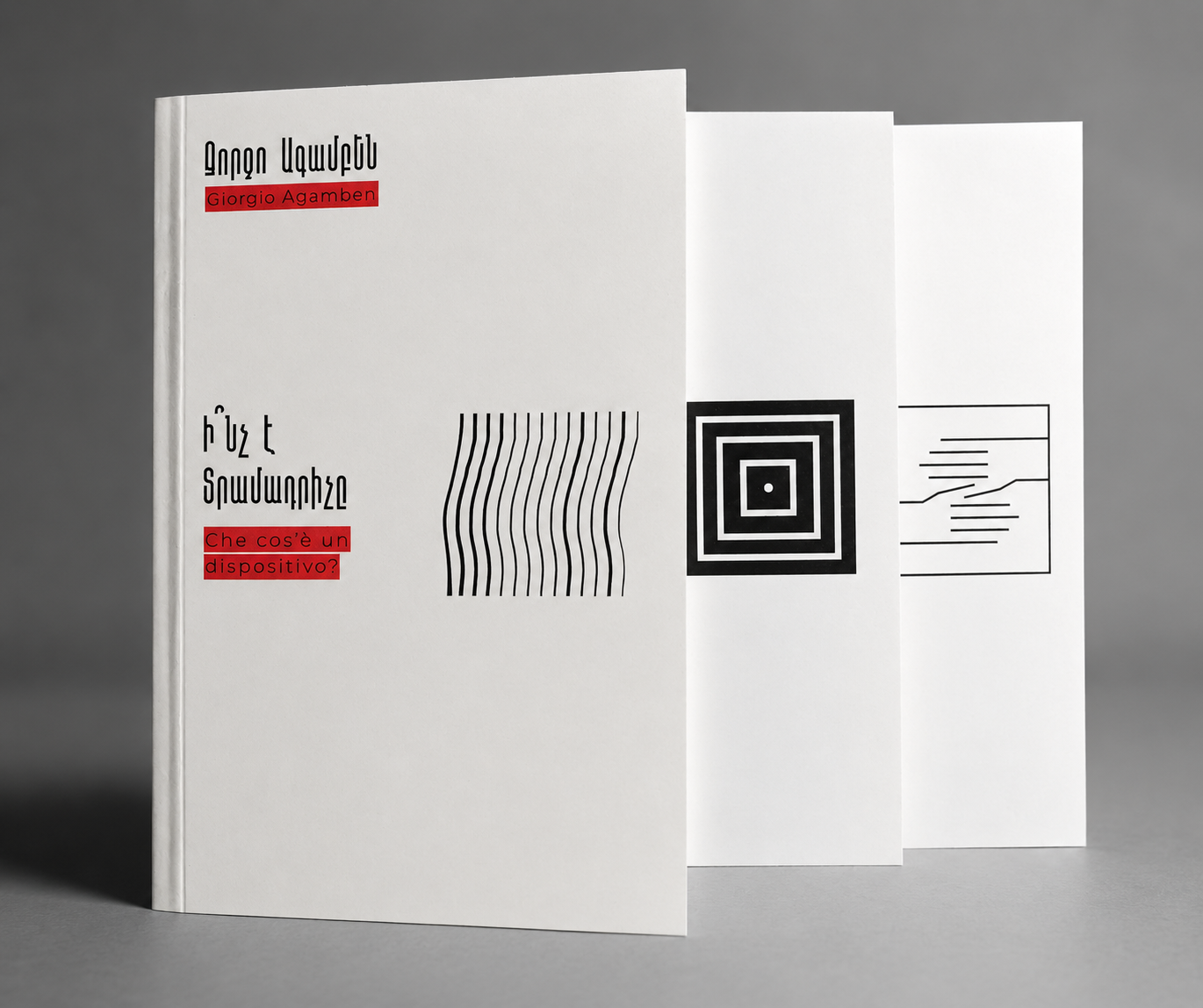
The three books offer a succinct introduction to Agamben’s recent works through an investigation of Foucault’s notion of the apparatus, a meditation on the intimate link of philosophy to friendship, and a reflection on contemporariness, or the singular relation one may have to one’s own time.
This publication was initiated by the translator Movses Der Kevorkian and aims at introducing to the young readers and students philosophical pieces by the outstanding author in a user-friendly, easy-caring and attractive pocket books format.
What is an Apparatus?, Western Armenian, 2021, 96p., paperback, 978-9939-9252-2-6
What is Contemporary?, Western Armenian, 2021,68p., paperback, 978-9939-9252-1-9
The Friend, Western Armenian, 2021, 60p., paperback, 978-9939-9252-0-2
About the author
Giorgio Agamben (1942) is one of the leading figures in philosophy and political theory. His unique readings of literature, literary theory, continental philosophy, political thought, religious studies, and art have made him one of the most innovative thinkers of our time.
Agamben was educated in law and philosophy at the University of Rome. As a post-doctoral scholar in Freiburg (1966–1968), he participated in Martin Heidegger’s seminars on Hegel and Heraclitus and was later a fellow at the Warburg Institute, University of London, from 1974 to 1975. Agamben then began teaching and–over the course of the next four decades–taught at a number of acclaimed European and American universities.
In addition to his important philosophical heritage, Agamben has critically engaged with religious and legal texts, as well as with some of the most important literary figures and poets in Western culture.
About the translator
The books were translated by Movses Der Kevorkian, a Lebanese architect. Movses now lives in Brussels, where he runs the Sill and Sound Architects office.
Inspired by various translation initiatives, he takes the first steps by translating philosophical essays into Western Armenian. The initiative is best described in his “translator’s foreword”.
“The starting point of this work as purely translation work is the training for the mind and the language. To work within the languages, with your language, sometimes to get closer to its borders, to your own borders, to open to old and new concepts, that is, to examine, to discover the dense structure of linguistic thinking. It is mostly foreign language publications that provide the opportunities for us to discover these contemporary concepts and approaches. This translation work therefore pursues two goals:
– Allow Armenian readers to explore, develop, and expand these current concepts in their own language;
– With the help of paper books encourage the reading of such works making them available for everyone.”